

The short answer
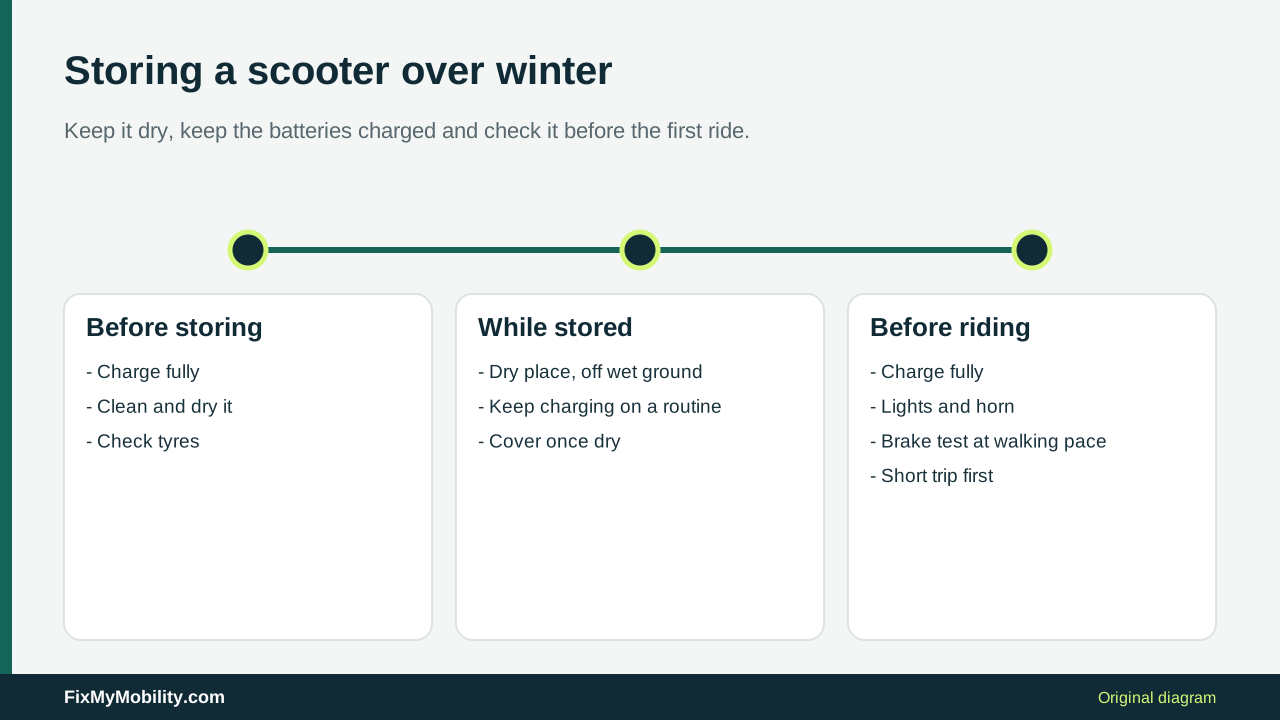
Keep the scooter somewhere dry and covered, ideally indoors, and away from freezing temperatures. Charge the batteries fully before you park it and keep charging them on the schedule in your handbook while it sits. Before the first ride in spring, charge it, check the tyres, lights and brakes, and book a service if one is due.
If you will still use the scooter every week through the colder months, read our guide to mobility scooter batteries in cold weather instead. That guide is about riding in the cold. This one is about putting a scooter away for a few weeks or months.
Pick the right place to keep it
Indoors is best. A hallway corner, spare room or utility room keeps the scooter and its batteries at a steady temperature. Pride Mobility, a large scooter manufacturer, recommends storing mobility products somewhere warmer in cold weather and, if that is not possible, at least in a garage, shed or covered area.
If the scooter has to live in a garage or shed:
- Use a cover made for mobility scooters, and only put it on once the scooter is dry.
- Keep it off wet ground and away from leaks or drips.
- Lock the shed or garage and take the key out of the scooter.
- If your model has removable batteries, think about bringing them inside. Pride notes that its batteries have a charging port on the battery itself, so they can be charged indoors.
Do not store the scooter where it blocks a way out of your home. If you live in a flat or council home, check the rules first. Woking Borough Council, for example, tells tenants that scooters must not be kept in communal areas and must never block doorways or escape routes.
Look after the batteries while it is parked
Batteries are the part most likely to be damaged by a winter in storage. Cold, damp and long periods without charging can all reduce how much charge a battery can hold. Strident, a mobility battery supplier, warns this loss can be permanent.
Before you put the scooter away, charge the batteries fully with the charger supplied for your model. After that, the right charging routine depends on your scooter and battery type, and published advice varies:
- Pride Mobility says to keep charging even when the product is not in use, at least once a week.
- Strident recommends a full charge around every six weeks for a battery in storage, and storing batteries indoors in a dry place.
Your handbook is the deciding source because it is written for your scooter. If you no longer have it, the manufacturer or a local repairer can usually tell you what applies.
Charge safely while the scooter is stored. Use the correct charger, let batteries cool after use before charging, and do not leave them charging while you are asleep. Woking Borough Council gives the same advice and suggests including a safety check on the charger as part of regular servicing.
Tyres, cleaning and covers
Wipe off mud and road grit before the scooter goes into storage, then let it dry completely. Covering a wet scooter traps moisture against the frame, seat and electrics.
If your scooter has air-filled tyres, check the pressure before storing it and again before you ride. The correct pressure is usually printed on the tyre wall or listed in the handbook. Solid or puncture-proof tyres do not need inflating, but look for cracks or flat spots when you take the scooter out again.
Do not open covers, disconnect wiring or take parts off to prepare for storage unless the handbook tells you to. Those jobs are for a repairer.
Before the first ride in spring
Give the scooter a few minutes of checks before you head out:
- Charge the batteries fully and check the charge indicator shows full.
- Check tyre pressure, or tyre condition for solid tyres.
- Test the lights, indicators and horn if fitted.
- Test the brakes at walking pace somewhere safe, such as a driveway.
- Look for warning lights or error codes on the display.
- Take a short trip close to home before a longer one.
If the scooter will not power up, see mobility scooter won't turn on. If it starts but runs out of charge much sooner than before winter, see mobility scooter losing power.
Is spring a good time for a service?
Often, yes. A scooter that has stood for months is a sensible candidate for a check before regular use, and many owners book one before the busier summer months. The right interval for your model is in the handbook and any warranty or service agreement. Our guide on how often a mobility scooter should be serviced explains what to look for.
When you call a repairer, ask:
- Can you service it at my home, or do you collect it?
- Does the service include a battery and charger test?
- What happens, and what does it cost, if you find a fault?
- How long will I be without the scooter?
Find mobility scooter servicing near you.
Common mistakes
- Putting it away flat. A battery left empty for weeks may not recover.
- Forgetting to charge it while stored. Set a phone reminder that matches your handbook's schedule.
- Using a different charger. Use the charger made for your scooter and battery type.
- Storing it in a communal hallway. This can break your tenancy rules and block escape routes.
- Assuming the battery is finished. A battery that seems dead after storage may need testing, not replacing. See how long mobility scooter batteries last.
When to call a repairer
Contact a repair business if the scooter will not charge, shows an error code, makes new noises, pulls to one side, or the brakes do not feel right. Stop using the battery and do not charge it if the case is swollen, cracked, leaking, unusually hot or smells of burning. Battery replacement and servicing listings show which businesses cover your area.
Sources and further reading
- Pride Mobility: storing your mobility product in colder weather
- THIIS: Strident on keeping mobility batteries winter ready
- Woking Borough Council: mobility scooter and e-bike safety
Sources checked 9 October 2026. Rules and guidance can change, so check the source before acting.
Your next step
Find a repair business · Book a service · Batteries in cold weather