

The short answer
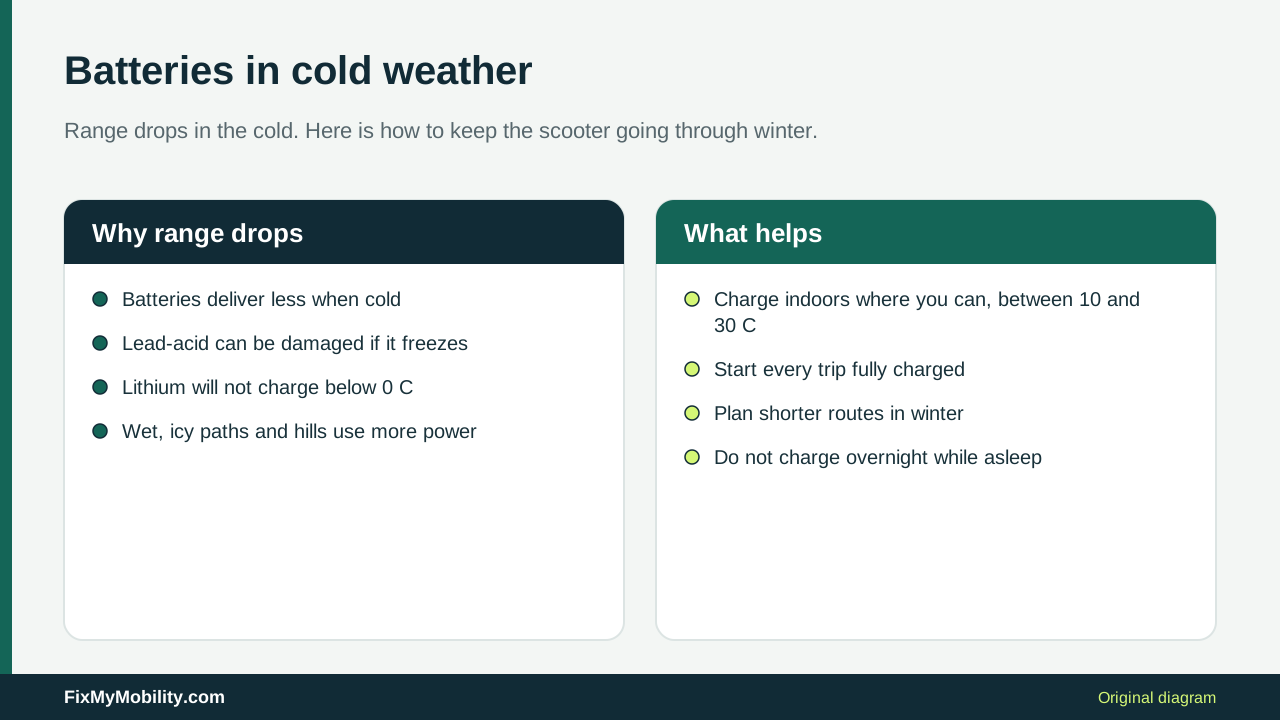
Batteries give less power in the cold, so most scooters will not go as far on a cold day as they do in summer. Keep the batteries charged on your handbook's schedule, charge them indoors, and start each trip with a full charge. If range stays poor once the weather is milder, have the batteries and charger tested.
This guide is for owners who keep using their scooter through winter. If yours is going into storage, see how to store a mobility scooter over winter.
Why your scooter goes less far in the cold
A battery makes electricity through a chemical reaction, and that reaction slows down as the temperature drops. Strident, a mobility battery supplier, explains that low temperatures reduce a battery's power and range. On a cold morning a fully charged battery has less usable energy to give than on a warm afternoon.
Hills, heavier loads, soft ground and stop-start trips all draw more power, so their effect is bigger in winter.
Temporary drop or lasting damage?
Some loss of range in cold weather is normal and comes back as the battery warms up. Lasting damage is different. Strident warns that cold, moisture and long periods without use can cause permanent capacity loss or failure. Pride Mobility, a scooter manufacturer, says prolonged freezing temperatures can make batteries gradually lose capacity until they become unusable.
The pattern tells you which one you have. If range is shorter on cold days but normal on milder ones, that is usually the temperature. If range stays short whatever the weather, or keeps getting worse, the battery may have lost capacity and should be tested.
How to charge safely through winter
- Charge indoors where you can. If the scooter lives in a shed or garage and the batteries can be removed, bring them inside to charge. Strident says most battery types are best stored at around 15°C.
- Keep to a routine. Pride says to charge at least once a week even when the scooter is not being used. Check your handbook for your model.
- Use the right charger. Use the charger supplied for your scooter and battery type. Strident warns against both overcharging and undercharging.
- Let batteries cool first. Woking Borough Council advises letting batteries cool after use before charging.
- Do not charge overnight while asleep. The same council advice says batteries should never be left charging while you sleep.
- Keep escape routes clear. Never charge or park the scooter where it blocks a door or hallway.
Lithium batteries and sealed lead-acid batteries have different charging needs (see lithium vs lead-acid batteries). Check the battery label or handbook to see which you have. If the handbook gives a temperature range for charging, stick to it.
Track your range so you can spot a problem
The simplest way to tell normal winter loss from a failing battery is to know what your scooter usually does. Pick a regular trip, such as the run to the shops and back, and note how much charge the indicator shows when you get home. Do it once in autumn and again on a few cold days.
If the cold-day figure is a little lower and recovers when it warms up, that is the temperature at work. If it drops a lot, or keeps dropping week after week, write down what you have noticed and take it to a repairer. Notes like these make a battery test quicker and help you avoid paying for parts you do not need.
Keep the rest of the scooter winter ready
- Lights. Check they work before the clocks go back and the evenings get dark.
- Tyres. Wet leaves and icy paths cut grip. Check tread and, for air-filled tyres, pressure against the handbook figure.
- Brakes. Test them at walking pace before each trip in wet weather.
- Water. Avoid deep puddles and flooded paths, and dry the scooter after wet trips.
- Grit and salt. Wipe road grit off the frame and wheels when you get home.
If anything feels different, such as the scooter pulling to one side or the brakes feeling soft, stop using it and contact a repairer.
Plan winter trips around the battery
- Start every trip fully charged.
- Plan shorter routes than you would in summer, with a way home if the charge runs low.
- Carry a charged mobile phone and the number of someone who can help.
- Use lights in low light and wear something visible.
- Dry the scooter after wet trips before it goes back under a cover.
Signs the batteries need testing
Book a battery test if:
- range stays poor in milder weather
- the charger shows full quickly but the scooter runs out early
- the scooter cuts out or slows sharply on hills
- the batteries were left flat for weeks or stored somewhere freezing
- the batteries are older than the life the manufacturer suggests
Stop using the battery and do not charge it if the case is swollen, cracked, leaking, very hot or smells of burning. Contact a repairer.
A short range does not always mean the batteries need replacing. Connections, the charger or another fault can cause similar symptoms. That is why testing matters before you buy new batteries. Our guides on a scooter losing power and how long batteries last go into more detail.
Questions to ask a repairer
- Can you test the batteries and the charger, and is that included in the first charge?
- Can you do this at my home?
- If the batteries need replacing, which type and size suit my model?
- What happens to the old batteries?
- Is there a warranty on new batteries?
Find battery testing and replacement near you.
Sources and further reading
- THIIS: Strident on keeping mobility batteries winter ready
- Pride Mobility: storing your mobility product in colder weather
- Woking Borough Council: mobility scooter and e-bike safety
Sources checked 9 October 2026. Rules and guidance can change, so check the source before acting.
Your next step
Battery testing and replacement · Find a repair business · Winter storage