

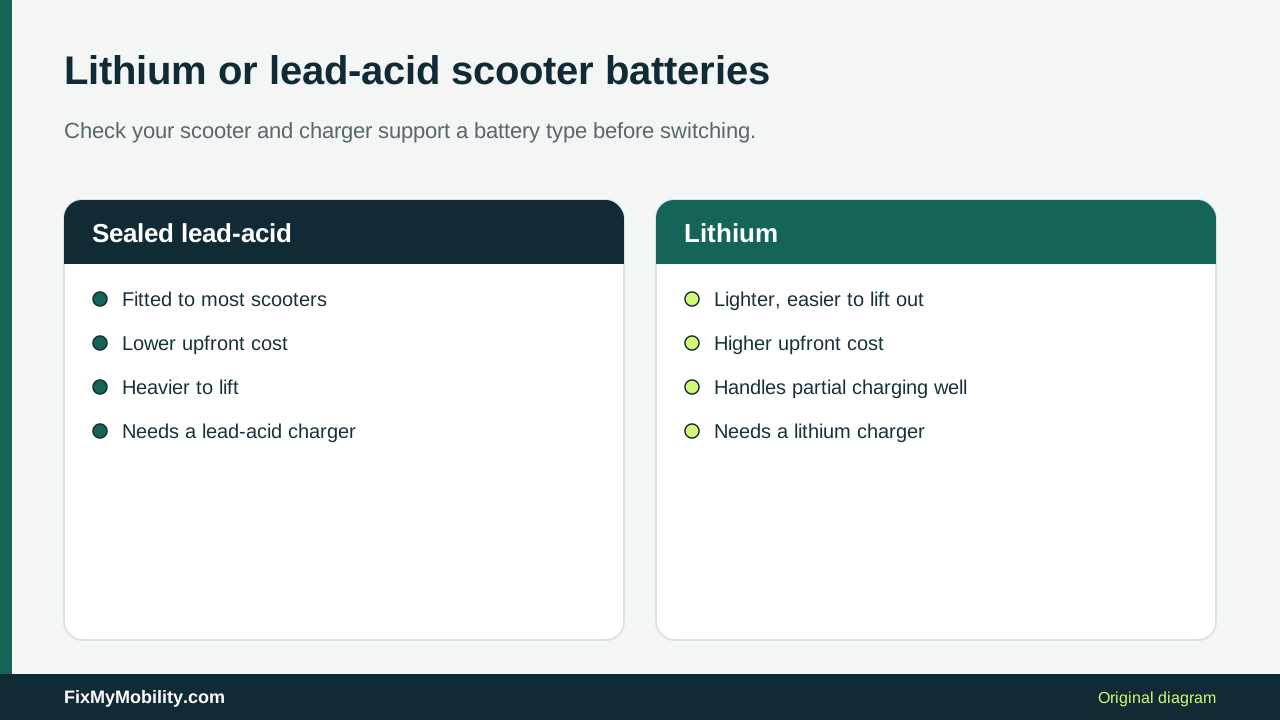
The short answer
Lithium batteries are lighter, usually go further per charge and last more charge cycles, but cost more upfront. Sealed lead-acid batteries (AGM or gel) are cheaper to buy but heavier and usually need replacing sooner. You can only switch to lithium if the new pack matches your scooter's voltage, fits the battery box and works safely with its electronics and charger, as Mobility World explains.
How they compare
Typical figures from Mobility World, which stresses they are typical, not exact:
| Lithium | Sealed lead-acid (AGM or gel) | |
|---|---|---|
| Weight | Roughly half. Around 10 to 15 kg for the same usable energy | A pair of mid-size batteries can weigh 24 to 30 kg |
| Charge cycles | Around 800 to 1,500 | Around 300 to 600 |
| Typical life | Often 4 to 6 years or more | Around 2 to 3 years with daily use |
| Range | About 20 to 40% more per charge | Lower |
| Charging | Faster, often a few hours | Slower, especially from flat |
| Upfront cost | Higher | Lower |
Your own results depend on your scooter, how you ride, the weather and how the batteries are charged and stored.
Which is right for you?
- Lead-acid suits owners who want the lowest upfront cost and whose scooter came with lead-acid batteries. It is the like-for-like replacement for most scooters.
- Lithium suits owners who lift the batteries out to charge, travel with a folding scooter, or want more range and a longer battery life, and whose scooter supports it.
If your scooter is under warranty, check with the supplier first. A non-approved battery may affect the warranty.
Before switching to lithium
Mobility World says the new pack must match the voltage, fit the battery box and work safely with the scooter's electronics and charger. In practice, ask a repairer to confirm:
- The pack is designed for your make and model, or is a recognised compatible replacement
- Which charger to use. Lithium and lead-acid packs usually need different chargers.
- Whether the battery gauge or controller settings need changing
- What warranty the new battery comes with
Charging safely
Most problems arise from damaged packs, cheap untested chargers or blocked escape routes, according to Mobility World. It advises charging in a ventilated area, away from communal escape routes, and not leaving batteries on constant charge. Woking Borough Council adds: let batteries cool after use before charging, and never leave them charging while you are asleep.
Stop using any battery that is swollen, cracked, leaking, very hot or smells of burning.
Cold weather, storage and travel
Both types lose range in the cold. See batteries in cold weather and winter storage. If you plan to fly with a scooter, contact your airline well before booking. Airlines set their own rules for battery-powered mobility aids, particularly those with lithium batteries.
Getting batteries replaced
Ask a repairer to test the batteries and charger before replacing anything, because short range can have other causes. When you book, ask which type and size they recommend for your model, the cost of each option, and whether they will take the old batteries away for recycling. See how long mobility scooter batteries last.
Common questions
Can I put a lithium battery in any mobility scooter?
No. The pack must match the voltage, fit the battery box and work safely with the scooter's electronics and charger, as Mobility World explains. Ask a repairer to confirm compatibility for your model.
Do I need a new charger for lithium batteries?
Usually. Use the charger specified for the battery you fit. Using the wrong charger is a common cause of battery problems.
How do I know which battery my scooter has?
Check the label on the battery, the handbook or the original paperwork. A repairer can also tell you during a battery test.
Are lithium batteries safe?
They are widely used, but safety depends on the pack and how it is charged. Mobility World says most problems come from damaged packs, cheap untested chargers or blocked escape routes. Use a matched charger, charge somewhere ventilated and stop using any damaged battery.
Sources and further reading
- Mobility World: lithium vs lead acid mobility scooter batteries
- Woking Borough Council: mobility scooter and e-bike safety
- THIIS: Strident on keeping mobility batteries winter ready
Sources checked 12 October 2026. Rules and guidance can change, so check the source before acting.
Your next step
Battery replacement · Find a repairer · Batteries in cold weather