

The short answer
Class 3 scooters may use the road at up to 8 mph and must be registered with DVLA. Class 2 scooters are for pavements.
No mobility scooter or powered wheelchair may use a motorway, a bus lane or a cycle lane painted on the road. A scooter that is faster, wider or heavier than the class limits is “not in a class”: road only, and you need a driving licence. Powered wheelchairs follow the same rules.
This guide follows GOV.UK’s Using mobility scooters and powered wheelchairs, the Highway Code and the Use of Invalid Carriages on Highways Regulations 1988, so it covers Great Britain: England, Scotland and Wales. Northern Ireland has its own section.
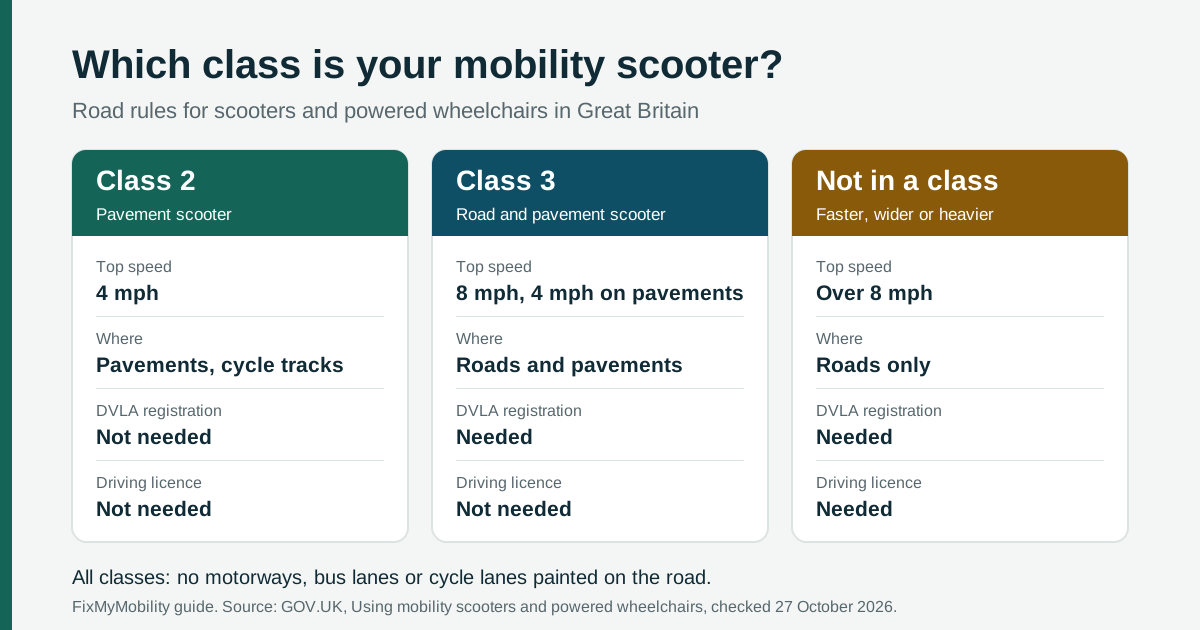
Class 2, class 3 and not in a class at a glance
GOV.UK puts mobility scooters and powered wheelchairs in class 2, class 3, or not in a class. (Class 1 is the law’s name for a manual wheelchair.)
| Class 2 | Class 3 | Not in a class | |
|---|---|---|---|
| Top speed | 4 mph | 8 mph on the road, 4 mph on pavements | Over 8 mph |
| Pavements, footpaths and bridleways | Yes, up to 4 mph | Yes, up to 4 mph with the 4 mph setting on | No |
| Cycle tracks | Yes | Yes | No |
| Roads | Only where there is no pavement | Yes | Yes, roads only |
| Motorways, bus lanes, cycle lanes | No | No | No |
| DVLA registration | Not needed | Needed | Needed |
| Driving licence | Not needed | Not needed | Needed |
| Insurance | Not required, but recommended | Not required, but recommended | Required if the total weight is over 254 kg |
| Eyesight | Read a number plate at 12.3 m | Read a number plate at 12.3 m | Read a number plate at 20 m |
| Minimum age | None set in the 1988 regulations | 14 | Outside the 1988 regulations |
Great Britain. From GOV.UK, the Highway Code (rule 42, class 2 on roads) and regulation 4 of the 1988 regulations (age).
How do I find out which class my scooter is?
Ask the seller or manufacturer. Otherwise go by top speed: 4 mph or less is usually class 2, and 8 mph is usually class 3.
Your handbook may say too. A scooter that can go faster than 8 mph, is wider than 0.85 metres or weighs more than 150 kg (200 kg with equipment you need, such as medical equipment) is not in a class. A class 3 must also have a setting that limits it to 4 mph, with an indicator showing when it is on (regulation 10 of the 1988 regulations), and once registered it has a DVLA log book (V5C). Buying used? Our second-hand buying guide lists what else to ask the seller.
Do you need a driving licence for a mobility scooter?
Not for class 2 or 3. GOV.UK asks for a valid driving licence only when a scooter or powered wheelchair is not in a class.
That last group is easy to miss. For a vehicle that is not in a class, GOV.UK lists a driving licence, DVLA registration and, for the heaviest, insurance. Cause an accident on one and you can get the same penalty as a car driver: prison, a driving ban or an unlimited fine.
Eyesight counts in every class. On class 2 or 3 you should be able to read a car number plate from 12.3 metres (40 feet); not in a class, you must read it from 20 metres and check regularly that you still can. GOV.UK says you can be prosecuted if poor eyesight causes an accident.
Can a class 2 scooter go on the road?
Only where there is no pavement, and with care. The Highway Code says class 2 users should always use a pavement when one is available.
GOV.UK lists the road as a place for class 3 and vehicles not in a class. The Highway Code (rule 42) adds that where there is no pavement, class 2 users should take care and, where possible, travel with the traffic. The Department for Transport’s table of legal requirements says a class 2 scooter used on the road between sunset and sunrise needs lamps and reflectors.
Do you need to register a mobility scooter with DVLA?
Yes, if it is class 3 or not in a class. Class 2 scooters do not need registering, and registered scooters pay no vehicle tax.
New scooters
The dealer will usually register a new scooter for you. If not, use form V55/MV; GOV.UK’s V55/MV page includes DVLA’s leaflet INF304, Registering a mobility vehicle, which lists the documents you need. The log book (V5C) should arrive within 4 weeks of the sale. Some older guides still name forms V55/4 or V55/5; V55/MV is the form GOV.UK names for mobility vehicles.
Used scooters
A used class 3 scooter should already be registered. Ask the seller, or use the DVLA vehicle enquiry service, before you pay. If it is not registered, use form V55/MV; GOV.UK says the log book should then arrive within 6 weeks of the sale.
What if the log book does not arrive?
Fill in form V62, Application for a vehicle registration certificate, and post it to DVLA, Swansea, SA99 1BA. It is a print-only form.
GOV.UK’s V62 page says to include a fee “if appropriate”, so read the form’s own notes rather than a figure quoted elsewhere. If you move house or change your name, fill in section 6 of the log book and send it to DVLA.
Do you need insurance for a mobility scooter?
Not for class 2 or 3, although GOV.UK recommends it. A scooter not in a class must be insured if it weighs over 254 kg.
That 254 kg is the total weight without attached equipment. FixMyMobility does not compare insurance; this section only covers what the law asks.
How fast can a mobility scooter go?
Class 2 tops out at 4 mph. Class 3 can do 8 mph on the road but must keep to 4 mph on pavements.
The Highway Code (rule 39) makes 4 mph a legal limit for every scooter on a pavement or in a pedestrian area, and you may need to go slower where the path is busy. A class 3 scooter must have its 4 mph setting on whenever it is on a pavement, and its speed indicator must work at all times (regulation 4). Anything that can exceed 8 mph is not in a class.
If your scooter has become slower than it used to be, that is a fault, not a legal limit: see why a scooter loses power.
Where can’t you ride a mobility scooter?
No scooter or powered wheelchair may use a motorway, bus lane or cycle lane. Scooters not in a class must also keep off pavements.
A vehicle that is not in a class also cannot use other pedestrian areas or cycle tracks. On dual carriageways, GOV.UK says to use an amber flashing light, and the Highway Code (rule 46) says not to use one with a limit over 50 mph; if you do, the beacon is compulsory.
Can you ride on a cycle track?
Yes in class 2 or 3. Cycle tracks are separated from the road; cycle lanes are painted on the road, and scooters cannot use them.
GOV.UK describes a cycle track as kept apart from the road by barriers or distance, while a cycle lane runs alongside the traffic. If in doubt, treat a painted line as a lane.
What are the rules on pavements, footpaths and bridleways?
Class 2 and 3 may use them at up to 4 mph. Make way for others and never leave the scooter blocking the way.
GOV.UK says to drive considerately. Normal parking restrictions apply, and the scooter should not be left where it gets in the way of others, such as wheelchair users and people with pushchairs.
Who is allowed to drive a mobility scooter?
Someone with trouble walking because of injury, disability or a medical condition. Others may use it only for set reasons, like taking it for repair.
GOV.UK’s other reasons are a manufacturer testing it, someone demonstrating it before it is sold, and someone training a disabled user. If none applies and you have an accident, you may get the same penalty as a car driver.
Is there a minimum age?
Yes for class 3: the 1988 regulations bar anyone under 14 from using one. The regulations set no minimum age for class 2.
This is regulation 4(c)(i) of the 1988 regulations, which apply in England, Wales and Scotland. GOV.UK’s current guide does not mention age.
Can a relative drive my scooter to a repairer?
Yes. GOV.UK lists taking the scooter to or from maintenance or repair as one of the few reasons someone without walking difficulties may drive it.
The usual rules still apply on the way, including the class 3 road kit and the age limit. If the fault affects the brakes, steering or controls, do not drive it at all; ask about a home visit or collection instead. Of the 46 businesses listed on FixMyMobility, 24 advertise home visits (our listing data, reviewed 13 October 2026). Read about repairs at home, or use Find a repairer to see who covers your postcode.
What must a class 3 scooter have to use the road?
Efficient brakes, front and rear lights and reflectors, indicators that double as hazard lights, a horn, a rear view mirror and a clear view ahead.
GOV.UK says the police could stop you if your scooter lacks these. The 1988 regulations add the 4 mph setting and speed indicator, a maximum width of 0.85 metres, and brakes that hold the scooter indefinitely on a 1 in 5 slope.
Owner checks before you ride on the road
With the scooter parked on level ground and switched on, and without touching the throttle, check these:
- Front and rear lights come on, and the reflectors are clean and not cracked.
- Both indicators flash, and the hazard setting flashes them together.
- The horn sounds. Test it at home, not on the road.
- The mirror is secure, not cracked, and shows the view behind you.
- The speed indicator shows when the 4 mph setting is on.
- Tyres show no visible damage, and pneumatic tyres are at the pressure in your handbook.
If a light, indicator, the horn or the mirror is not working, keep off the road until it is fixed. If the brakes feel different, or the scooter rolls when stopped on a slope, stop using it and book a check. Do not adjust brakes, wiring or the controller yourself: the brake problems guide explains what to tell a repairer.
The clocks went back on 25 October 2026, so more trips now end in the dark. The Highway Code (rule 43) says lights must be used at night, and suggests reflective strips or a reflective jacket at dusk and even in daylight.
What should a service check for road use?
Ask for the lights, indicators, horn, mirror, 4 mph switch and brakes to be checked at each service, with a written note of the results.
GOV.UK’s guide sets no service interval, but the kit above is the legal minimum for a class 3 scooter, so a service is the natural time to check it alongside the battery, tyres and steering. See how often to service a scooter and the service checklist. When you book, ask:
- Will you check the lights, indicators, hazard lights, horn and mirror?
- Will you test the brakes, including whether they hold on a slope?
- Do you check the 4 mph setting and the speed indicator?
- Can you visit me at home, or collect the scooter, if I cannot ride it to you?
Find mobility scooter servicing near you.
Mistakes to avoid
On 27 October 2026 we read eight UK guides that came up in our searches for these questions, written by retailers and an insurer. Seven never mentioned vehicles that are not in a class, the group that needs a driving licence. Three named older DVLA forms instead of V55/MV. Only one explained cycle tracks and cycle lanes, and none mentioned Northern Ireland. Three more mistakes to avoid:
- Riding a class 3 scooter on the pavement with the 4 mph setting off.
- Letting anyone under 14 use a class 3 scooter.
- Buying a used class 3 scooter without checking that it is registered.
Does the law differ in Northern Ireland?
Northern Ireland’s Highway Code uses the same classes and speed limits. The registration, licence and insurance steps in this guide cover Great Britain only.
The Highway Code for Northern Ireland on nidirect has its own rules 36 to 46, under Northern Ireland’s own regulations: 4 mph on footways and footpaths, 8 mph for class 3, no motorways, and an amber beacon on dual carriageways over 50 mph. When we checked on 27 October 2026, nidirect did not say whether a class 3 scooter must be registered there. nidirect says DVLA handles vehicle registration and the Driver & Vehicle Agency (DVA) licensing and testing, so ask them before relying on the Great Britain steps above.
Common questions
Do the same rules apply to powered wheelchairs?
Yes. GOV.UK uses the same classes and the same road, pavement, registration and eyesight rules for powered wheelchairs and mobility scooters. If yours needs work, see powerchair repairs.
Do Blue Badge parking concessions apply to scooters?
Yes. The Highway Code (rule 45) says Blue Badge parking concessions apply to scooters and powered wheelchairs displaying a valid badge. Normal parking restrictions apply otherwise.
Sources and further reading
- GOV.UK: Using mobility scooters and powered wheelchairs
- GOV.UK: The Highway Code, rules 36 to 46 for powered wheelchairs and mobility scooters
- GOV.UK (Department for Transport): legal requirements for mobility scooters and powered wheelchairs on the road
- GOV.UK (DVLA): register a mobility vehicle (V55/MV)
- GOV.UK (DVLA): apply for a vehicle registration certificate (V62)
- legislation.gov.uk: The Use of Invalid Carriages on Highways Regulations 1988
- nidirect: Highway Code rules 36 to 46 for Northern Ireland
- nidirect: Driver & Vehicle Agency (DVA) Northern Ireland
Sources checked 27 October 2026. Rules can change, so check GOV.UK, or nidirect in Northern Ireland, before you rely on them. FixMyMobility is a directory of repair businesses and does not give legal advice.
Your next step
Find mobility scooter servicing · Find a repairer near you · What a service should include