

The short answer
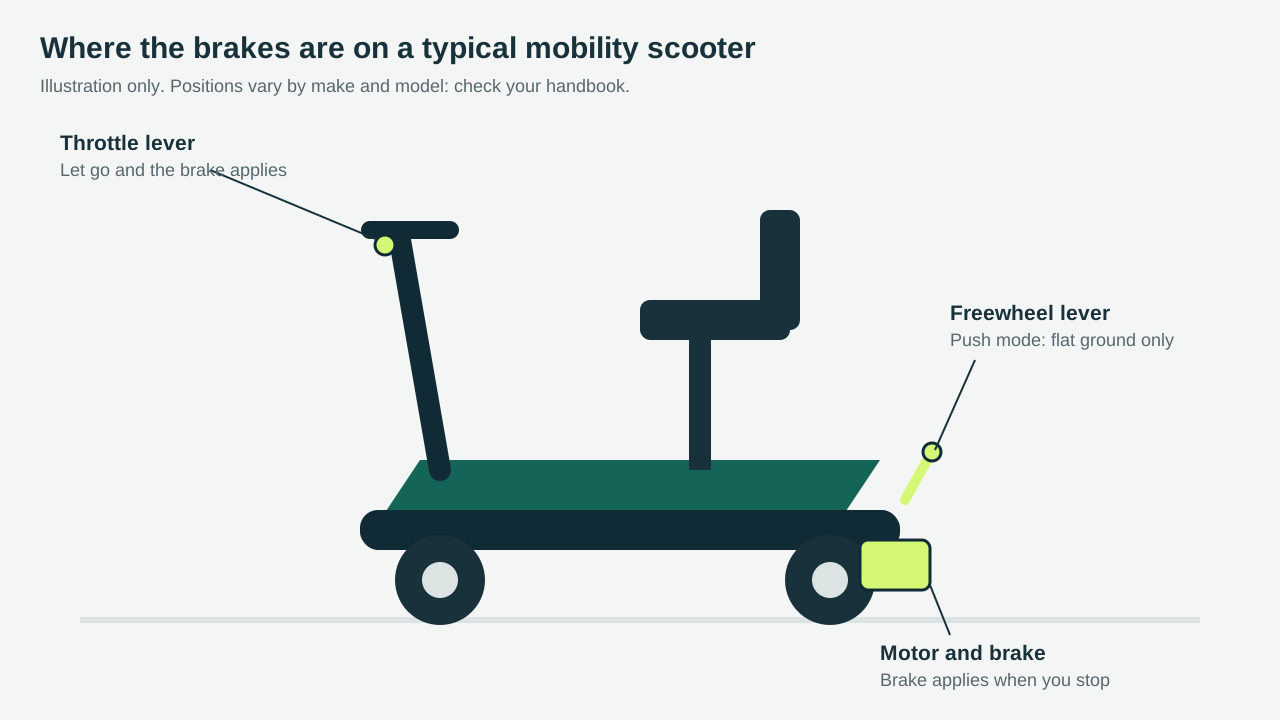
Most mobility scooters stop using an automatic electromagnetic brake that applies as soon as you let go of the throttle lever. A freewheel lever releases that brake so the scooter can be pushed. If stopping feels different, the brake makes new noises, a warning light shows or the scooter will not drive, stop using it and book a repair. Brakes are safety-critical, as Mobility World points out.
How mobility scooter brakes work
According to Mobility World, the main brake on most scooters is an automatic electromagnetic brake that engages the moment you release the throttle, so there is no separate brake lever to pull. Some larger class 3 road scooters also have mechanical or drum brakes.
In everyday use this means the scooter slows as you ease off the throttle and holds itself when stopped, including on gentle slopes.
The freewheel lever
The freewheel lever, sometimes marked N and D or drive and push, releases the motor brake so the scooter can be pushed by hand. Its position varies by model, so check your handbook.
- Only use freewheel on flat ground. One manufacturer's handbook, for the Aspire HS928, says freewheel is recommended only on flat surfaces, never on gradients, and that you should never leave the scooter on a gradient with the motors disengaged.
- Put the lever back to drive straight after pushing. Mobility World warns that if freewheel is left engaged, the automatic brake will not engage and the scooter may roll freely.
- On many models the scooter will not drive while the lever is in freewheel. If yours powers on but will not move, check the lever before assuming a fault.
Warning signs of a brake problem
Mobility World lists these signs:
- An unusual noise when the scooter slows down, which can point to wear inside the brake
- Longer stopping distances, which can mean the brake is losing grip or needs adjusting
- Pulling to one side when stopping
- A warning light, which should be checked by a qualified engineer rather than diagnosed at home
- The scooter rolling when it should hold, which may mean freewheel is still engaged or the brake is not working
Never bypass the brake
Some people search for ways to bypass a scooter's brake, usually because it will not move or is hard to push. Do not do it. The brake is what stops the scooter and holds it on slopes. A bypassed brake can let a scooter roll into a road or down a hill. If the scooter will not move, check the freewheel lever is in drive, switch off and on again as your handbook describes, then call a repairer.
Brake faults and a scooter that won't move
An electromagnetic brake fault can stop a scooter driving at all, often with a flashing light or error code on the display. On many models a small switch tells the controller where the freewheel lever is, and a fault there can stop the scooter too. These are jobs for a repairer with the right test equipment. Note what the display shows and tell the business when you call. See also scooter won't turn on.
Booking a brake repair
- Tell the repairer the make and model and exactly what has changed
- Mention any warning light, error code or noise
- Ask whether they can inspect at home or need to collect the scooter
- Ask for a written estimate before parts are replaced
Brake checks should be part of every service. See our mobility scooter service checklist.
Common questions
Do mobility scooters have brakes?
Yes. Most use an automatic electromagnetic brake that applies when you let go of the throttle lever, so there is no separate brake to pull. Some larger class 3 scooters also have mechanical brakes.
Why does my scooter roll back on a slope?
Stop using it on slopes and check the freewheel lever is in drive. If it still rolls, the brake may not be holding properly and needs a repairer straight away.
Can I push my scooter if it breaks down?
Usually, using the freewheel lever, but only on flat ground. The Aspire HS928 handbook warns against using freewheel on gradients. Put the lever back to drive as soon as you stop pushing.
How much does a brake repair cost?
It depends on whether it is an adjustment, a switch or a full brake replacement, plus labour, travel and parts for your model. Ask for a diagnosis and a written estimate first. See what goes into a repair quote.
Sources and further reading
Sources checked 12 October 2026. Rules and guidance can change, so check the source before acting.