

Is a second-hand mobility scooter worth considering?
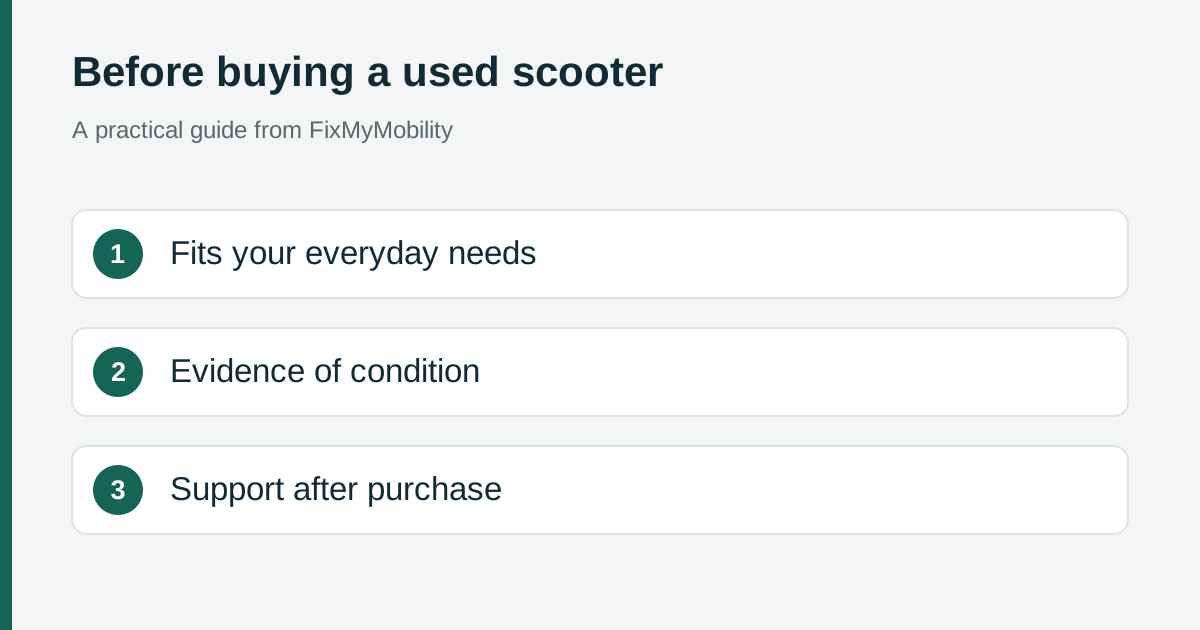
A second-hand mobility scooter can be worth considering when it suits your needs, its condition is understood and you know who can maintain it. Start with suitability and evidence, then compare the asking price. A scooter that cannot be stored, charged, transported or serviced in your circumstances is not a good purchase simply because it costs less.
This guide helps you organise questions before viewing a used scooter. It is not a stock list or a recommendation of a particular seller. FixMyMobility currently helps people find repair businesses; a listing does not mean that the business sells scooters, offers pre-purchase inspections or has inspected an individual machine. Confirm those services directly.
The MHRA's guidance on buying used scooters highlights checks including the manufacturer's indicated service life, the handbook, necessary servicing, and suitable batteries and charging equipment. Those basic documents are a useful starting point. If the seller cannot identify the scooter or explain its history, pause before paying a deposit.
Start with your journeys, storage and transport
Write down where you expect to use the scooter. Consider pavement conditions, slopes, access to shops and the space available at home. Describe those journeys to a knowledgeable retailer or assessor and ask whether the exact model is intended for them. Do not choose solely from an advertised maximum range or speed.
Think through the complete trip. Can you reach the storage space, move through the doorway, turn where needed and charge according to the handbook? If the scooter will travel in a car, arrange a demonstration using your vehicle. A claim that a model is “portable” does not establish whether you can manage its heaviest component or whether it fits your boot.
Folding and dismantling are also different arrangements. Ask the seller to demonstrate the process for the exact scooter and show how each part is secured afterwards. Avoid trying to lift a component beyond your capabilities. The useful test is whether your actual routine works with suitable assistance where needed, not whether someone else can fold the scooter quickly.
Ask for the exact identity and history
Request the manufacturer, full model name, serial number, approximate age, handbook and available service records. Photograph the identification label with the seller's permission so you can ask about parts support before purchase. A familiar-looking scooter may have different battery or charger requirements from another version of the same range.
Ask how the seller acquired it, why it is being sold and what work has been done. A recent invoice is more informative if it identifies the scooter, the work and the business that completed it. Clarify whether a “service” meant an inspection, a battery replacement or a wider repair. Treat missing history as missing information, rather than filling the gaps with an optimistic assumption.
Check whether the scooter still has manufacturer support and whether a relevant repair business accepts the model. You can find a repairer and ask about support before committing. Do not ask a business to endorse a scooter remotely from a single photograph; explain that you want to know whether it can maintain that model and whether an inspection is available.
Battery age is only one question
Ask when the batteries were fitted, who supplied them and whether there is a receipt or recent assessment. Find out what evidence the seller has for their condition. A dashboard showing a full charge is not the same as a documented assessment of usable performance.
For practical budgeting, ask a repairer for the fitted price of a compatible replacement if testing finds it necessary. Include that possible cost in your comparison without deciding in advance that the batteries are faulty. Our guide to how long scooter batteries last explains why age alone does not settle the question.
Ask to see the supplied charger and its identification details. If it is missing, damaged, unlabelled or has been substituted, obtain manufacturer or qualified supplier advice before using it. The MHRA warns about non-approved or modified battery and charger combinations. Do not accept “the plug fits” as proof of compatibility, and do not test an unfamiliar charger simply to see whether it works.
What to observe during a viewing
Arrange a viewing where the seller can demonstrate the scooter safely. Look for a clear description of its condition and ask about damage, storage and previous repairs. If there is something you cannot assess, write it down for a professional rather than taking covers off or making adjustments.
Useful observations to discuss include:
- Visible tyre damage, unusual wear or an apparently flat tyre.
- A seat, armrest or tiller that feels insecure during a demonstration.
- New noises, warning indicators or a fault that appears intermittently.
- Broken lights, damaged charging connectors or missing supplied parts.
- Evidence that the equipment differs from the seller's description.
- Missing information about repairs, batteries or the correct charger.
This is a viewing checklist, not a pass certificate. A clean exterior can conceal a fault, while an honest cosmetic mark may have little relevance to the suitability of the scooter. Ask an appropriately experienced business to assess anything material before you decide.
Arrange a suitable demonstration or test
Ask for a demonstration before attempting to drive unfamiliar equipment. You need to understand the controls, stopping behaviour, seating and the manufacturer's instructions. If you are uncertain about suitability or transfers, seek appropriate professional advice rather than using the seller's reassurance as a substitute for an assessment.
A short demonstration can help you notice whether you can reach the controls and sit comfortably. It cannot establish every aspect of reliability or battery range. Avoid being pressured into a demanding route, a slope or an environment you are not comfortable using. Do not deliberately reproduce a suspected brake or control fault.
If the scooter has a known fault, ask whether an independent assessment can be arranged before purchase. Agree who pays, what is being checked and whether the report goes to you. A repair business may be unable to offer this service, so confirm it rather than assuming an ordinary repair appointment includes purchase advice.
Compare the full first-year commitment
Make a short budget with separate lines for the purchase, delivery, assessment, any agreed immediate work, routine servicing and suitable storage. Add only costs you have actually been quoted; keep uncertain items as questions. Optional cover or accessories should also be identifiable rather than disappearing into a vague total.
Consider two fictional choices. One scooter has a lower asking price but no charger or service history. Another costs more and comes with documented checks and clear aftercare. The first might still be considered after suitable assessment, but its asking price is not the complete comparison. The second is not automatically reliable merely because documentation exists. Read what the paperwork actually covers.
Ask who will help if a problem appears after delivery. If a written warranty is offered, check the provider, duration, covered items, exclusions and the process for arranging work. Avoid assuming every refurbished or “approved used” scooter has the same warranty: those labels and terms differ between sellers.
Questions for a dealer and a private seller
With a dealer, ask who inspected the scooter, what was checked, which parts were replaced and what support is offered afterwards. Ask whether the dealer will service the model and how collection works if it cannot be driven. Get any promised work and supplied accessories recorded with the sale.
With a private seller, be especially clear about what evidence is available and what you still need to establish. Ask for a receipt identifying the seller, scooter and agreed items. Check the terms and your position before making payment; this guide does not treat dealer purchases and private sales as interchangeable agreements.
In either case, pause if essential information cannot be obtained, the scooter cannot be demonstrated appropriately, or the seller will not allow reasonable questions. You do not need to resolve every uncertainty immediately. It is reasonable to take the model details away and seek advice before deciding.
A viewing record you can keep
Record the model and serial number; asking price; seller details; handbook; service records; battery evidence; charger specification; observed issues; inspection arrangements; delivery; warranty promises; and any questions still unanswered. Use the same headings for each scooter you consider.
This makes comparisons easier after a viewing, particularly if several machines look similar. Keep the record factual: “seller says batteries replaced last year; receipt not yet supplied” is more useful than “batteries good”. Separate what you observed, what the seller said and what a professional confirmed.
Common buying questions
Should I buy a used scooter that needs repairs?
Only after you understand suitability, the fault, parts support and the likely complete cost. A low asking price is not enough evidence. Ask whether a suitable professional can assess it before you agree to the purchase.
Does refurbished mean the battery is new?
Do not assume that. Ask which work was completed, whether battery performance was assessed, which components were replaced and what the written sale terms say.
Can FixMyMobility sell me a scooter?
This guide does not offer scooters for sale. You can use the directory to ask relevant businesses about model support or inspection services, and confirm directly whether any business also sells equipment.
Before you commit
Keep your priorities in order: the right equipment for your circumstances, understandable condition and history, a workable support route, then the complete price. If you are weighing a used replacement against repairing what you own, start with a clear repair quotation so the two options can be compared fairly.
Check whether an inspection is available locally
JJ Mobility in Poole advertises pre-purchase inspection on its own website, alongside work in Poole, Bournemouth and surrounding areas. If that area fits, ask whether it can inspect the particular scooter before you buy, what the report covers and what the charge will be.
This is an inspection enquiry, not a scooter sales offer or a recommendation to buy a particular machine. The listing does not confirm an appointment or that every model can be assessed. Elsewhere, use the scooter repair directory to ask about model support; a repair listing alone does not establish that pre-purchase inspections are offered.
Sources and further information
- MHRA: buying and maintaining mobility scooters, including second-hand equipment
- TGA Mobility: a manufacturer’s used-scooter buying guide
Sources checked 19 October 2026. Prices and service terms can change. Follow the instructions for your exact equipment.